AI Full-Stack Development Bootcamp
From LLM fundamentals to enterprise deployment, covering the full technology stack of DeepSeek, Dify, MCP, and FastGPT — 24 lessons to systematically master the core skills of AI application development
Course Overview
Comprehensive Technical Depth
From LLM fundamentals like Transformer and MoE architectures to application development platforms such as DeepSeek, Dify, and FastGPT — build a complete AI full-stack knowledge system.
Project-Driven Learning
Master production-ready solutions through real-world projects including a Xiaohongshu copywriting assistant, code generation Agent, WeChat intelligent customer service, and enterprise-grade RAG systems.
Enterprise-Grade Industry Enablement
Provides methodologies adaptable to finance, healthcare, education, and other industries, including data security, access control, and compliance strategies to accelerate enterprise AI transformation.
Cutting-Edge Technical Vision
Explore the latest technologies such as DeepSeek-R1, MCP/A2A protocols, model fine-tuning, and distillation — stay ahead of LLM application trends and the competitive landscape.
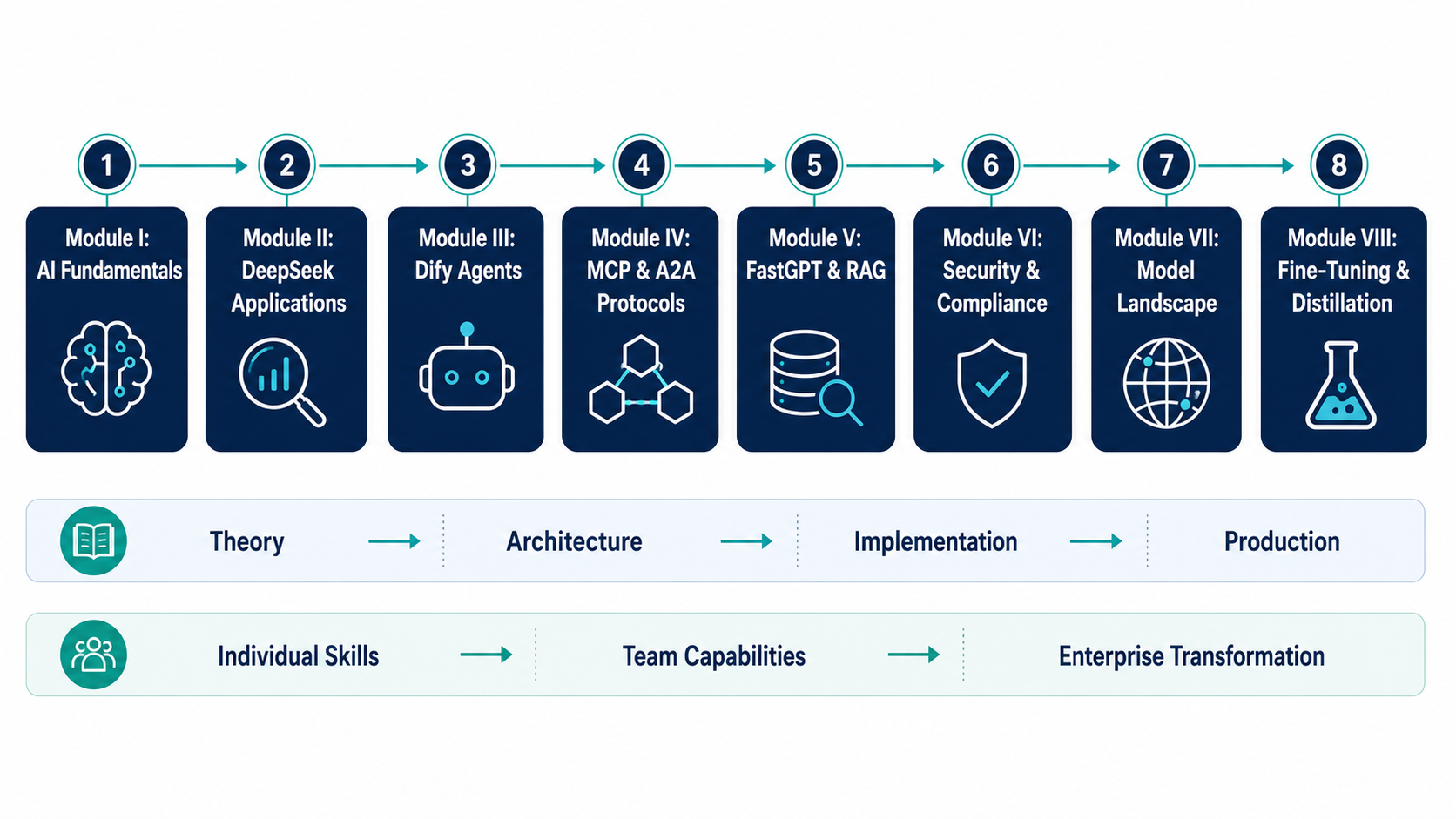
Course Projects
All course code and hands-on projects are open source. A full-stack development quick-start guide based on the DeepSeek API — fork it as the starting point for your own projects after completing the course.
Core Technology Stack
DeepSeek
A leading open-source LLM series spanning V1–V3, the R1 reasoning model, and the multimodal VL2, supporting both API access and private deployment — the core model foundation of this course.
Dify
A no-code/low-code Agent development platform offering workflow orchestration, prompt management, conditional branching, and iterative debugging — rapidly build intelligent customer service and code generation Agents.
MCP / A2A
The Model Context Protocol (MCP) enables standardized connections between LLMs and external tools/data; the A2A protocol breaks down Agent capability silos to enable multi-agent collaboration.
FastGPT
An enterprise-grade RAG development framework integrating knowledge base Q&A, workflow orchestration, and automated data processing — ideal for intelligent customer service, knowledge management, and complex business process automation.
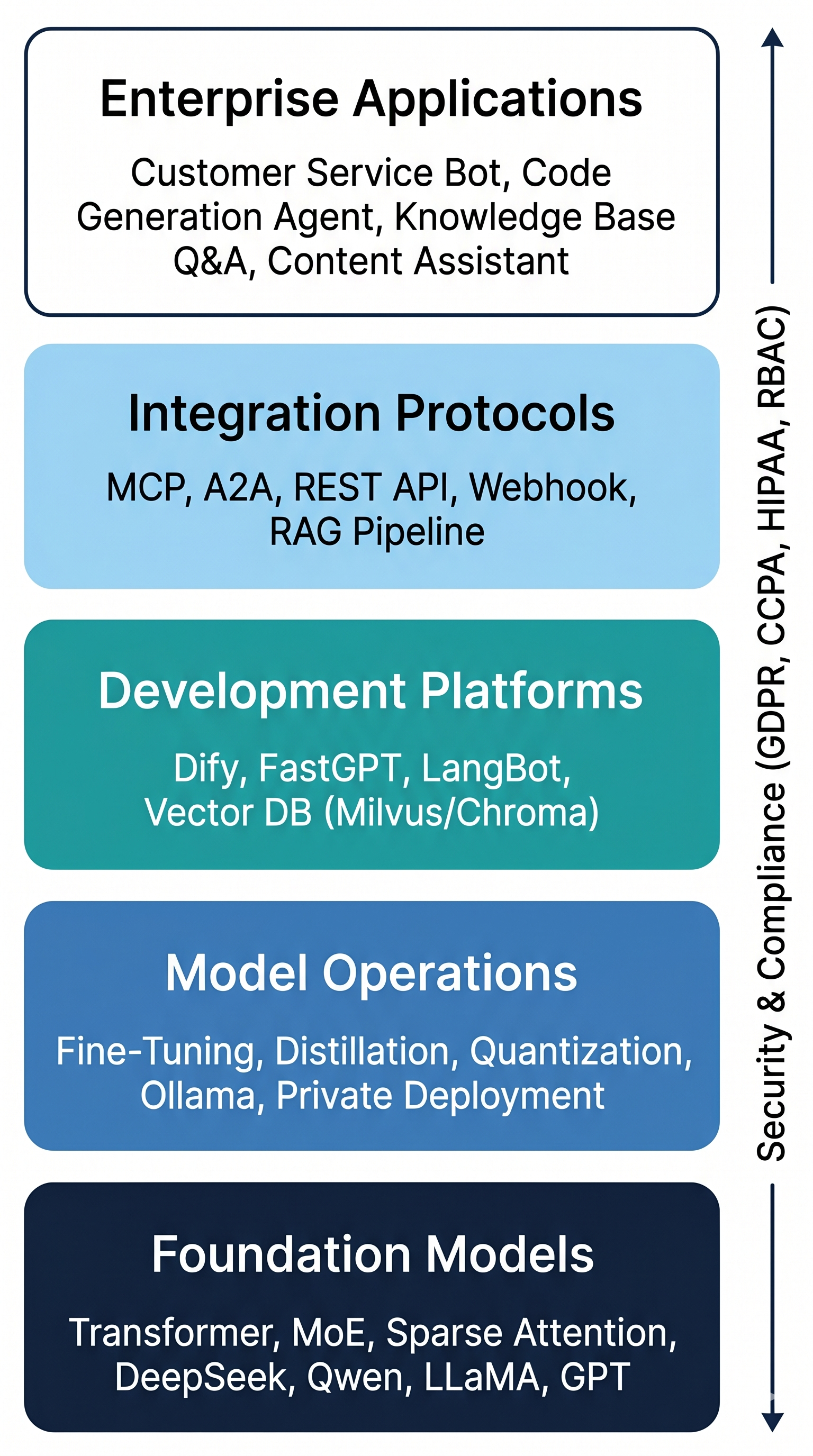
Core Value
Core Technology Decoded
Master the architectural principles of LLMs including Transformer and MoE, and gain deep understanding of Agent design, workflow orchestration, and cross-modal model invocation strategies.
Full-Stack Capability Building
From FastAPI service deployment to Docker/K8s containerization, master enterprise-grade system architecture, automated workflows, and cross-platform API integration.
Scenario-Based Application Enablement
Become proficient in prompt engineering and template design, RAG and vector database practices, and deliver intelligent solutions for code generation, knowledge base Q&A, and more.
Industry Frontier Breakthroughs
Interpret the latest advances in leading LLMs worldwide, master cross-industry Agent application replication, and learn best practices for security compliance and privacy protection.
Learning Outcomes
- Systematically master the full-stack LLM knowledge system from machine learning theory to Transformer and MoE architectures
- Independently develop multiple types of AI Agents including RAG-powered Q&A, a Xiaohongshu copywriting assistant, and automated code generation
- Proficiently use Dify and FastGPT platforms for workflow orchestration, and deploy across WeChat, DingTalk, and other platforms via LangBot
- Master MCP/A2A protocols to build standardized LLM and external tool integration solutions, enabling multi-agent collaboration
- Acquire enterprise-grade capabilities for DeepSeek model private deployment, fine-tuning, and distillation, meeting data security and compliance requirements
Detailed Syllabus
01 AI Fundamentals & Core Technologies
Lesson 1: Machine Learning & Deep Learning Theoretical Foundations
- Core algorithms and application scenarios of supervised learning, unsupervised learning, and semi-supervised learning
- Neurons, activation functions, forward/backward propagation, and gradient descent optimization
- Classic network architectures: fully connected networks, CNN, RNN, and deep learning frameworks
Lesson 2: The LLM Landscape & Key Technologies
- Transformer architecture: self-attention mechanism, multi-head attention, and positional encoding
- Sparse attention (Longformer/BigBird) and Mixture of Experts (MoE)
- Model compression and acceleration: quantization (INT8/FP16) and knowledge distillation
02 DeepSeek LLM Applications & Agent Development
Lesson 3: DeepSeek — Status, Applications & Technical Innovations
- The viral rise of DeepSeek: why it went viral, what it is, and how long the momentum will last
- DeepSeek prompt engineering best practices and code generation hands-on
- DeepSeek V1–V3 milestone models and key technical analysis of the R1 reasoning model
Lesson 4: Building Your First RAG with DeepSeek
- DeepSeek API development platform and multi-vendor API service integration
- Vector database principles, architecture, and selection (Milvus/Chroma, etc.)
- RAG system architecture and workflow — hands-on development of an intelligent Q&A system
Lesson 5: Building a Xiaohongshu Viral Copywriting Assistant
- Agent fundamentals: concepts, working mechanisms, and core capabilities of LLM + Agent
- DeepSeek Agent architecture and prompt task decomposition strategies
- Hands-on: copywriting generation logic design, evaluation optimization, and automated deployment
Lesson 6: DeepSeek Private Deployment & Best Practices
- Private deployment use cases: finance, healthcare, government, and other high-privacy industries
- Technology selection: FastAPI/Flask service deployment, Docker/K8s containerization, Ollama
- Hands-on: Ollama-based DeepSeek private deployment and performance evaluation
03 Dify Workflow Orchestration & Intelligent Agent Development
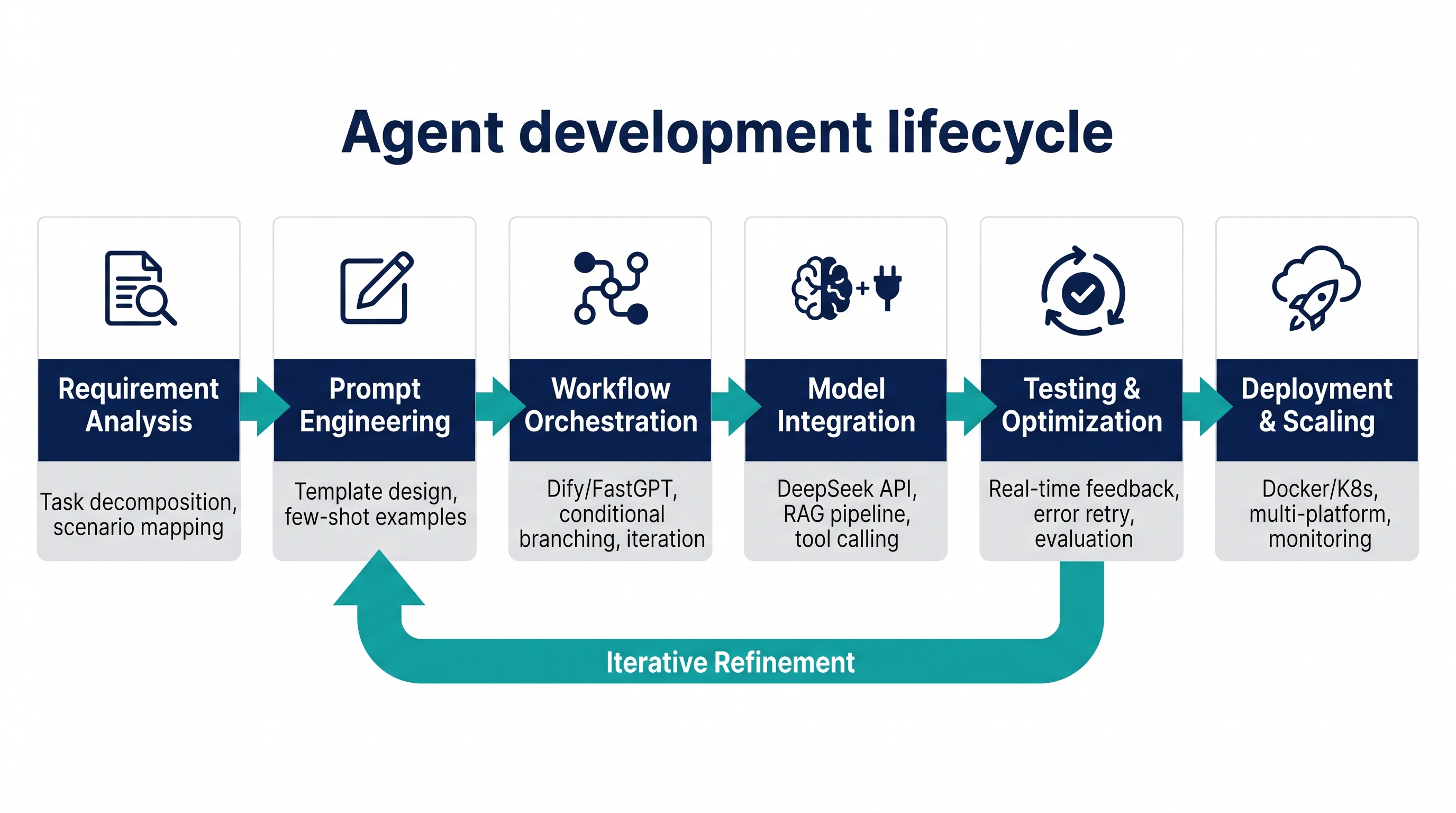
Lesson 7: Getting Started with the Dify LLM Application Platform
- Dify platform positioning, core features, and technical architecture
- Docker environment setup, application creation, debugging, and preview
- Hands-on: build an AI image generation app and intelligent customer service bot with Dify
Lesson 8: LangBot Instant Messaging Bot Platform
- LangBot core advantages: multi-platform support, MCP protocol compatibility, and high-stability design
- Multimodal conversation capabilities and JSON/YAML dynamic configuration hot-reload
- Hands-on: deploy LangBot via Docker and integrate with personal WeChat
Lesson 9: Dify + LangBot Multi-Platform Intelligent Customer Service Agent
- Multi-platform intelligent customer service solution: rapid integration, unified management, and multimodal support
- DingTalk bot and WeChat Official Account integration hands-on
- Advanced features: multi-application type adaptation, timeout handling, and error recovery mechanisms
Lesson 10: Building an Automated Code Generation Agent with Dify
- System architecture: requirement input -> Dify workflow -> DeepSeek model -> code execution feedback
- Efficient prompt design, asynchronous execution, and automatic retry mechanisms
- Hands-on: automated code generation and debugging for a Snake game and company website
04 MCP/A2A Protocols & Multi-Agent Collaboration
Lesson 11: Introduction to the Model Context Protocol (MCP)
- MCP core architecture: Hosts, Clients, Servers, and the transport layer
- Core concepts: Resources, Prompts, Tools, Sampling
- MCP ecosystem and community support
Lesson 12: MCP Deployment & Development Hands-On
- Developing MCP clients and servers using Python/C# SDK
- MCP Inspector debugging techniques and performance optimization
- Advanced applications: complex workflow integration and security mechanisms
Lesson 13: A2A Protocol & Its Synergy with MCP
- A2A core architecture, Agent Card, and interaction flow explained
- Comprehensive comparison of MCP and A2A: core differences, technical layering, and scenario selection
- Hands-on: A2A official Python HelloWorld example walkthrough
05 FastGPT Enterprise Knowledge Base & Advanced RAG
Lesson 14: Enterprise Knowledge Base & Q&A System Design
- Enterprise data governance, knowledge base requirements analysis, and architecture design
- LLM-based Q&A system architecture and performance optimization
- Enterprise-grade challenges: scalability, fault tolerance mechanisms, and resource scheduling
Lesson 15: Getting Started with FastGPT
- FastGPT positioning: core features and use cases of the enterprise-grade RAG development framework
- Docker deployment and key configurations: model services, vector database, data storage
- Knowledge base construction: document upload, automatic segmentation, and Q&A pair generation
Lesson 16: Building an Enterprise-Grade Intelligent Q&A Agent with FastGPT
- Workflow orchestration: user intent classification -> knowledge base retrieval -> formatted output
- API integration and authentication (JWT/API Key) with performance monitoring metrics
- Hands-on: end-to-end development and optimization of an enterprise-grade intelligent Q&A Agent
06 Enterprise Application Security & Cross-Industry Best Practices
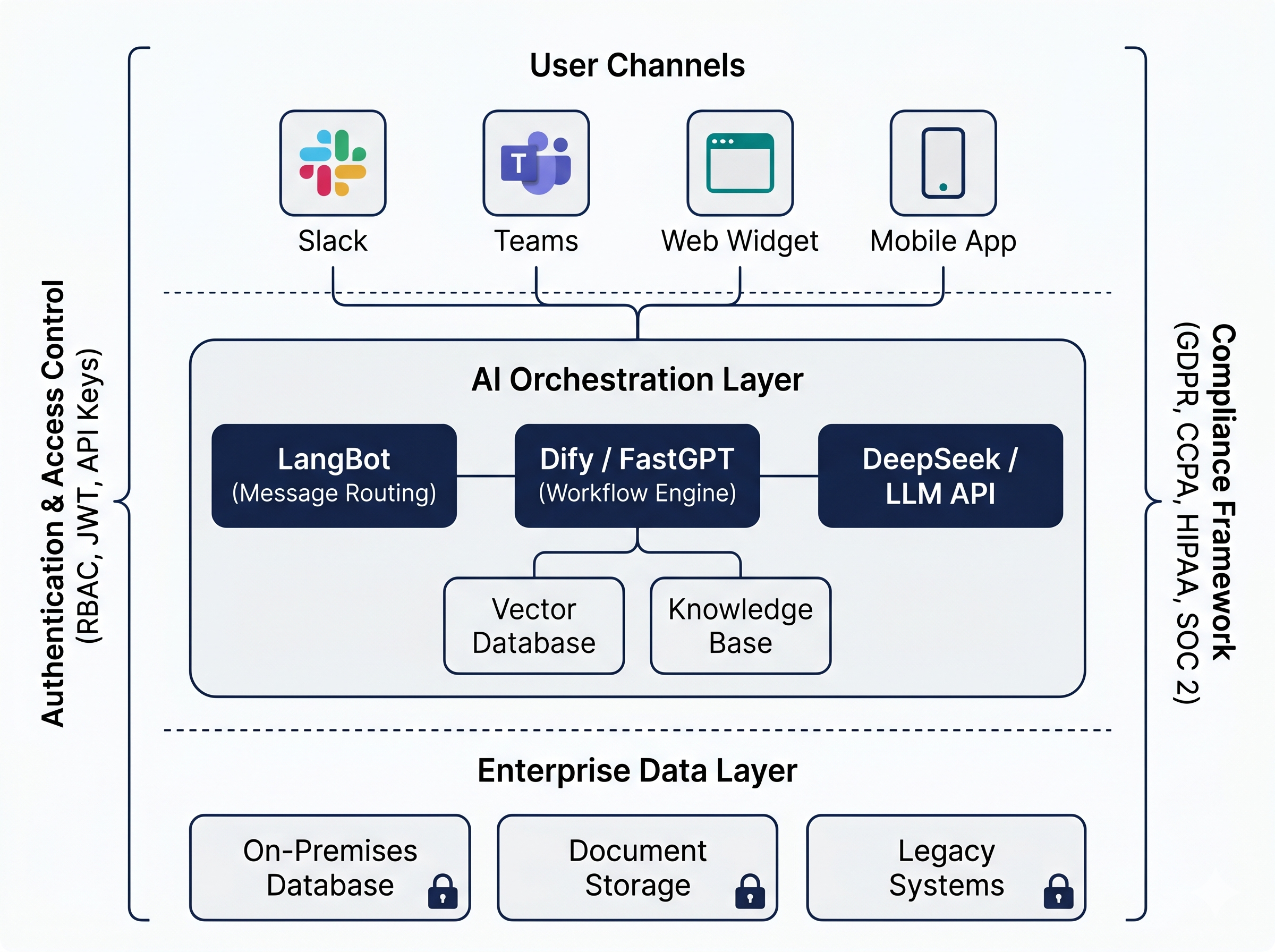
Lesson 17: Role-Based Access Control & Data Privacy Protection
- RBAC access control design: administrators, developers, and regular users
- Data privacy protection: differential privacy, federated learning, and data anonymization
- Data compliance assurance: GDPR, Cybersecurity Law, and audit monitoring
Lesson 18: Cross-Industry Experience Replication & Application
- Cross-industry gap analysis and intelligent customer service solution portability
- Intelligent customer service adaptation and optimization for finance, healthcare, and education
- Case study: intelligent customer service migration from finance to retail — practices and lessons learned
Lesson 19: Cross-Industry Code Generation Agent Experience Replication
- Common requirements and customization adjustments for code generation across industries
- Code generation needs in financial risk control, medical electronic health records, and automated grading in education
- Case study: code generation practices and efficiency gains from enterprise tools to cross-platform applications
07 LLM Competitive Landscape & Model Fine-Tuning/Distillation
Lesson 20: Model Technology Roadmaps Led by International Giants
- OpenAI GPT series (GPT-1 to GPT-4 Turbo) and o1/o3 reasoning series
- Meta LLaMA, xAI Grok, Anthropic Claude, and Google Gemini series
- Key technical breakthroughs and competitive landscape analysis for each model
Lesson 21: Advanced Open-Source Models Led by Domestic Pioneers
- DeepSeek series: technical evolution of V1–V3 and the R1 reasoning model
- Alibaba Qwen series: Qwen-VL multimodal, Qwen2.5-Max, and QwQ reasoning model
- Global LLM competitive landscape and technology development trends
Lesson 22: Trends & Challenges in LLM Applications
- Future directions: multimodal fusion, green AI, and Artificial General Intelligence (AGI)
- Quantum computing meets LLMs, model safety, and ethical regulations
- AI talent demand trends and career development paths from developer to manager
Lesson 23: DeepSeek-R1 Model Fine-Tuning & Case Study
- Fine-tuning fundamentals: data preparation, preprocessing, and training evaluation workflow
- Hands-on: a complete case study of model fine-tuning with DeepSeek
- Industry-specific customized training: tailored datasets and personalized solutions for specific needs
Lesson 24: Hands-On DeepSeek-R1-Qwen Small Model Distillation
- Distillation fundamentals: strategies for reducing inference costs and improving deployment efficiency
- Distillation workflow: dataset construction, temperature adjustment, loss functions, and knowledge transfer
- Hands-on: GPU environment setup, distributed training, and small model performance evaluation
Instructor
Jingtian Peng
Founder / CEOFounding member of Huawei 2012 Lab deep learning team. UC visiting scholar. Former technical partner at Caicloud (acquired by ByteDance in 2020), co-founder & CTO of Pinlan Data (raised ~¥200M). Kubeflow maintainer, TensorFlow contributor, Linux CNCF program committee member.